How to Grow Willow
Basic lingo to get us started:
Basket willow is any variety of willow (Salix) that has an upright growth habit (distinguishing it from weeping varieties) that has a pliable wood fiber structure and narrow pith making the rods suitable for weaving.
Basket willow could be either a wild variety of willow, native to the place within which it grows. But predominantly, basket willow most often refers to domesticated varieties that have been grown specifically for basket weaving. Domesticated willow has been grown selectively for its pliability, variation in bark colors, and a growth habit that produces straight, slender rods with little branching.
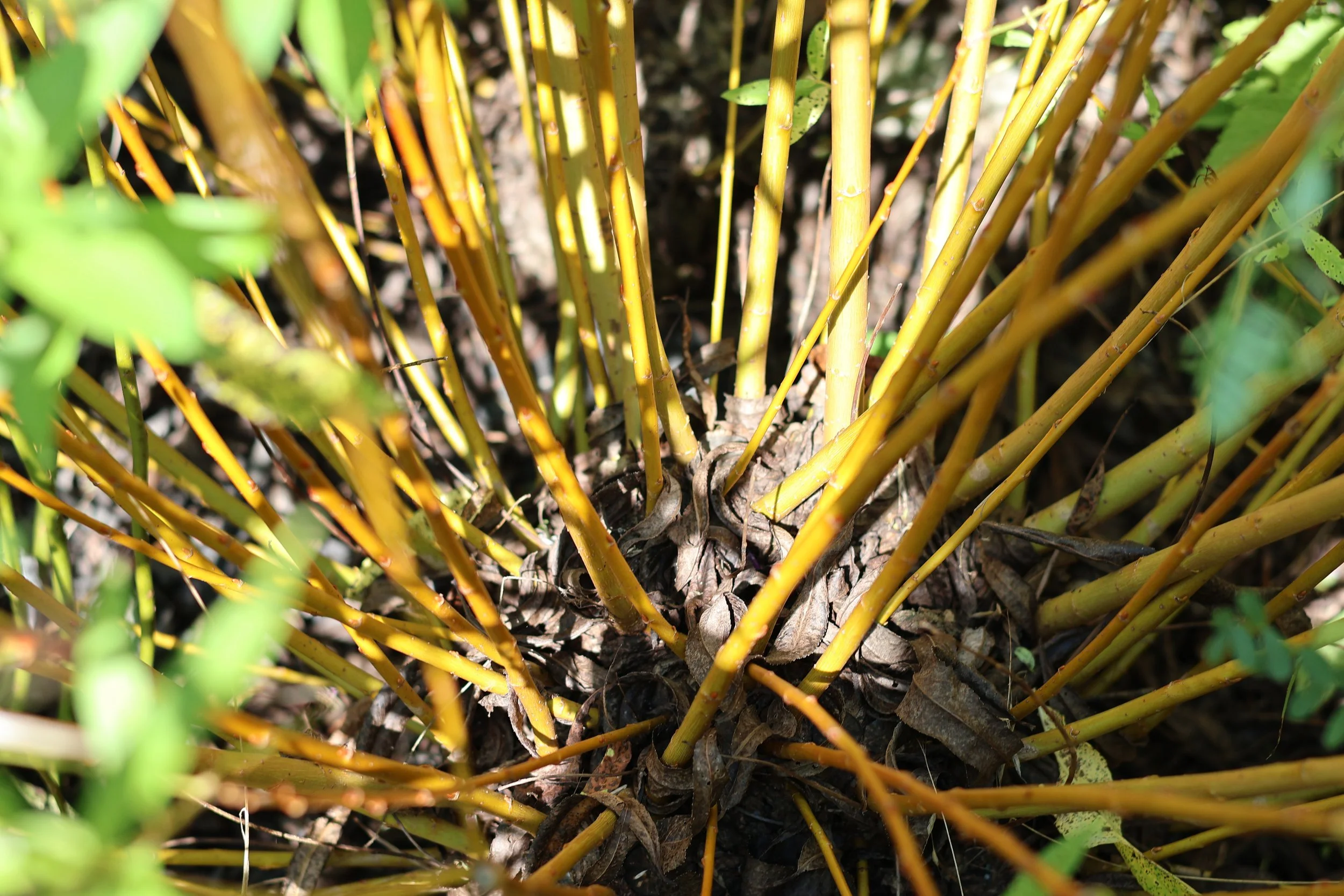
Stool—the “trunk” of a Coppice willow. The knot at the top of a pollard willow trunk
Rods or whips—the straight branches harvested from basket willow.
Tips—the tip of the rods
Butts—the base of a willow rod
Coppiced willow is harvested every year by cutting the rods to the ground as tightly to the stool as is possible. (In willow communities, we refer to that as the stool looking like a fist, rather than an open hand)
Pollarded willow is harvested every year for weaving. But can be harvested on a 6-7 year cycle for firewood. Also cut as close to the “stool” as possible. But that stool is the thick bulb that forms at the top of the trunk that’s been allowed to grow 2-4’ tall. (Could be taller, but gets harder to harvest).
Where to plant basket willow:
Full sun—8 hours a day is best during the growing season
Where they have access to water—but that can mean a lot of different things. Most don’t like waterlogged roots.
They don’t much care about their soil make-up. Not in heavy clay, but otherwise they grow like weeds in loads of different soil types. Unless you have straight clay soil or straight sandy beds, you needn’t add much to make them thrive.
How to plant willow:
All basket willow should be planted during the dormant season—December through early March here in the Ohio River Valley. Coppiced plants at anytime in that window. Pollarded plants should go in toward the end of the dormant season.
All basket willow should be planted as a dormant root-free cutting—either a 10-12” stick no narrower in diameter than a pencil for coppiced plants, or a 3-5.5 foot rod for pollards. Pollard rods should be no narrower than a pencil at the top end of the rod.
Coppice Cuttings made at harvest time can remain viable for 1-2 months if stored in a plastic bag (mostly closed) in refrigeration. I store mine in ziplock bags with an inch or 2 unzipped in the loft of our horse barn.
Pollard Rods should be planted within a week or two of having been harvested for best results. Can be viable for about a month.
Never store willow cuttings for planting in water, but you can put them in a bucket of water 24 hours before planting to plump them up a bit and get them starting to think about producing roots.
Willows HATE having their roots disturbed. Success rate for planting root-free is incredibly high. Nearly 100%. Potting them before planting and then replanting? The success rate is very low. 50-60% if you’re lucky.
And if you want to participate in old timey growing, all of the U.S. historical records I’ve found from the 1800’s state that willow should be harvested during a waning moon and planted during the waxing moon. I’m sure those farmers knew something I don’t, but that’s not always an easy planting/harvesting rule to fit into the schedule.
Planting Coppice starts:
Coppice starts should be pushed into cleared ground until just a bud or two are above ground. If you plan to mulch, maybe 3 buds. Plant coppiced willow no more than a foot apart and no less than 8” apart. *Except select X-LARGE varieties. Miyebeanas, for example, could be spaced 2 feet apart.
Willow, when starting out for the first year or two, does not like competition. At 65willows, we plant ours in cleared beds—six to ten feet wide and through weed suppression fabric. You could also lay down cardboard and mulch on top of that once your starts are planted. By their third year, they should grow thickly enough that they shade out most other grass or weeds.
Planting Pollard starts (we don’t sell pollard starts, but you could multiply your own willow in this way from next year’s rods. They should be a foot+intended height of stool in length):
Pollard starts should have at least a foot pushed into the ground. More would be better. Plant pollarded willow in staggered double rows, 2-3 feet apart and then 3-4 feet apart from the next doubled rows.
Special notes:
If you plant pollarded willow at the proper height for your grazing animal (no goats), a willow field can make excellent pasture for small donkeys, geese, ducks, and chickens. Donkeys and sheep will eat willow, unless it’s grown above head height. Once pollarded willows have matured and developed their crowns in the late spring, ducks, chicken, and geese can graze below with protection from airborne predators.
How water affects willow. . . They don’t like waterlogged roots but they also hate to be dry for extended periods. If you hit a drought, you will need to water your willows. In a drought, dry willow plants completely shut down growth. When it rains again and the drought ends, they will grow again by starting new side branches on the rods that stopped growing. And now all of your beautiful straight rods for weaving will become a branchy mess.
Growing willows on swales is excellent, especially if there’s run off from higher ground. But the only place for swales on my property is downhill north facing. They get loads of water, which is great, but the lower plants on the swale slope have gotten shaded out and some are struggling.
Have low expectations of your willow for a year or two. They’ll make just a few rods each plant and many varieties are branchy their first year or two. But as they fill out and grow more rods, they will start having to compete with one another to reach the sun and their rods will grow longer, more slender, and less branchy (barring drought complications). I typically use my first year willow for starts for more plants.
If you are growing your willow as an ornamental, I suggest coppicing your willow plant each year for at least two years. That will encourage them to make more rods from their stool and to fill out in an aesthetically pleasing way. Also, new growth is the most colorful growth. Old growth tends to go gray, black, or dusty brown.
Every willow plant has an expected growth habit and an expected bark color. I have found these expectations to be more like suggestions of how they might turn out. Everything grows differently in different locations and different soils. A juane de falais is never going to be any color other than yellow into orange, but it can be short and stocky in one location and grow 12 foot rods in another. I have both outcomes on my farm. I have a purpurea on the farm that is producing slender rods on all plants—but pale green on one end and green with a strong red overcast on the other end of the farm.
Pests and Diseases
Willows are susceptible to a bunch of pests and diseases. The worst for me have been willow blight, Japanese beetles, Giant black willow aphids, and deer. There’s some bunny activity but not enough to make me sad.
Japanese beetles are easily remediated using traps from your hardware store.
Aphids don’t hurt the plants but their honeydew makes them dirty and could, under the right conditions, attract blight. You can spray for those or just spray them off with water. You could also purchase live lady bugs as soon as the aphids appear and disperse them. We have used lady bugs—4500 to about an acre of beds and 2 weeks later, no more aphids, but there is still honeydew residue I hate. Hopefully we’ll get them earlier in coming years.
Blight will crush your willows if not treated. But for me it always starts as tip wilt and then quickly the stem down into the rod turns solid black. Nothing else looks like it. If you see evidence of blight, cut away the affected bits, get rid of them far away, wash your hands, clothes, and bleach your clippers. Then spray your willows with a mixture of 1 gallon water to 1TBSP of Baking soda and a squirt or two of dawn dish soap. The baking soda mixture changes the PH of the plants just enough that blight fungal growth can’t progress.
Willow midges are a real problem in the UK. I haven’t seen much from them here or anything similar.
Spotted Lantern Fly are definitely here now. I haven’t seen their damage in the willows yet and I don’t know how to eradicate them, but I squish everyone I see. I expect we’ll also try praying mantis predators for them in the coming years.
Willow Pinecone Gall Midges will set up shop in black willow, Salix nigra. It doesn’t hurt the plant, but it does somehow convince the willow to make galls shaped exactly like rounded pinecones. Rather than being a pest, these midges have helped me identify some of our wild willow as Salix nigra.
If you have questions in the future, feel free to reach out.
I’m also on Instagram and Facebook where I announce upcoming classes as “65willows”.
Additionally, there are a number of great Willow crafting and growing groups on facebook.
And, last but not least, look for Hanna Van Aelst on YouTube. She is my teacher and mentor and is very generous with knowledge about growing willow and basic weaving projects. Plus, she’s located in Ireland, so beautiful scenery and accents abound in all of her videos.