Truman Lowe
I used to live in Chicago. I worked in marketing at a private arts college on Michigan Ave. I miss it. A little. Chicago felt like home. I was there for close to two decades. It was a huge city that I moved to and navigated on my own. I met wonderful people. I struggled. I did good work. I learned and failed and learned some more. I grew and expanded and found a huge chunk of chosen family there.
So, when we decided to move back to Cincinnati to give Archer the opportunity to grow up like I did—half city mouse and half country mouse—I felt like I had to shrink myself to make a place in my old home town. I was a stay at home mom. I lived in a place where I had to much more regularly be someone’s kid, someone’s sister, to live up to, or down to, my family’s narrower expectations of who I am. I landed what I thought was going to be my dream job, only to find out I was terribly terribly wrong about the mission of the organization. It was a hard transition.
I don’t miss the traffic of Chicago, or the expense, or of the way big cities seem to make a person feel caught up in capitalism and the need to consume and consume and consume. . . Or feel like a failure for not doing so. But I do miss my community and Dan’s musical community. I miss my haunts and the train—its rumble and blue sparks and strange collection of passengers. I miss the skyline and the feeling of being a part of something huge that I had to work hard to maintain a place in. And I miss the lake. Oh, how I miss the lake and its changeability—deep iron gray one day and then a pale Caribbean green the next.
But we’re here in Cincinnati now and have been for nearly a decade and that homesickness for Chicago has definitely subsided. What hasn’t diminished, however, is how funny my big city friends think it is that I am here and that I’m a farmer, that I have traded in my knee-high leather boots and Boden dresses for muck boots and overalls. And so I have become the repository for so many of their found stories about farming.
Almost every week, old city friends send me articles about pollinator die off or interesting factoids about willow or political commentary about farmers’ all voting against their own best interest in the last election (note: #notallfarmers). I love it. Even if the articles they send me contain information I already know or have already read. (I live in Cincinnati, in a “fly over” state, but, you know, I’m still able to get my hands on the New York Times.) It means they’re thinking about me fondly, and who doesn’t love that?
The new friends I’m making here in Cincinnati, “get me” and the life I’m living here a bit better, though. And their recommendations for reading material or something I might be interested in checking out often make more sense. Abby suggesting I read “Braiding Sweetgrass”. Danny putting me on the tail of some great Bluegrass group I hadn’t heard of before. Beth suggesting a restaurant here that she knows I will love and might fill the hole of some favorite Chicago restaurant I’ve left behind.
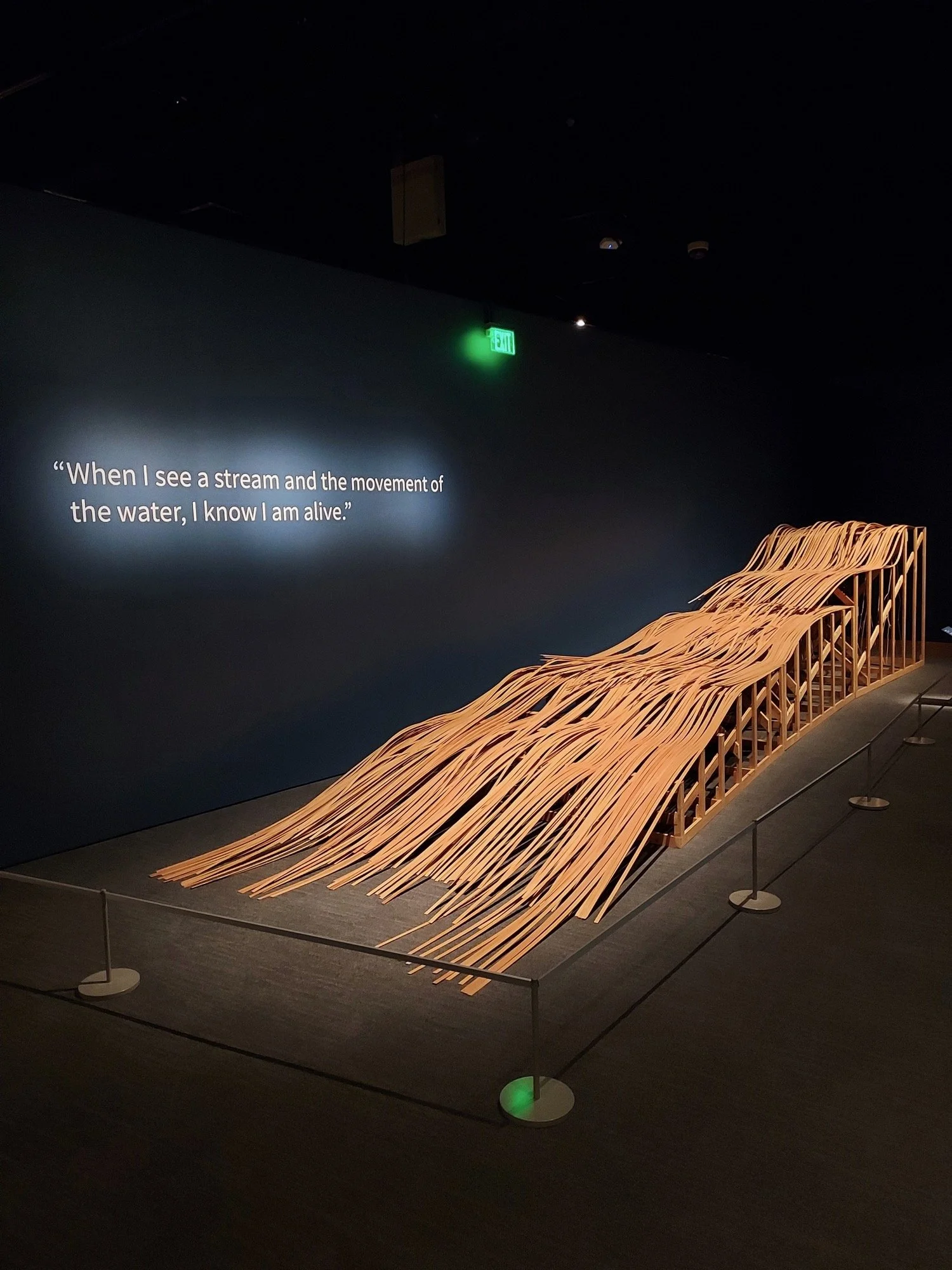
Just yesterday, Catfish made a beeline for me at Richard’s bar to share an exhibit he had seen in DC at the National Museum of the American Indian—Water’s Edge: The Art of Truman Lowe. The pictures attached to this post are his—taken in large part so he could show me and make sure I checked Lowe out. You can see the installation through January of 2027. Run don’t walk.
I hadn’t heard of Truman Lowe before Cat turned me on to him. His work speaks to me though—a lot of willow, his main energy seems to be trying to depict water, its movement and light reflection and our attachment to it. Growing willow near the Great Miami River, I definitely see his work and know it in ways I might not another artist’s.
The other thing I love about him, though, is that it’s another artist to share with Abby—my willow working friend. She’s a sculptor and game for learning to make baskets with her smart hands. But I’m always keen to send artists using willow her way in the hopes that I will be able to hold her attention with the possibility of work with willow that could hold her attention longer term. Whatever it takes to keep her.
