Remember when I said that thing about “balance”?
That was yesterday? Two days ago?
We’ll, today, I was driving to the farm when I got a text from my brother’s business partner, Justin, asking if I thought it was possible to plant sweet grass in marshy land just above his and my brother’s orchard. I told him I hadn’t the foggiest idea, but immediately cue the giant eye roll.
I love when anyone gets curious about planting things down here or trying something new. I get excited about their excitement. It’s fun to watch the process and the learning unfold. But sweet grass? That’s not just his project. That’s a willow weaving adjacent project that I’m going to get roped into.
I wouldn’t even read Robin Wall Kimmerer’s “Braiding Sweet Grass,” though Catfish recommended it to me on easily five different occasions. So worried was I that it would be an invitation to another art form that required the same level buy in as willow growing and weaving, that that was a hard pass.
I didn’t end up reading the book until Abby insisted and gave me a copy for Christmas. Turns out it’s not remotely a how to and it radically changed the language and thoughts I have about community, parenting, and craft. And Abby’s and my shared reading of “Braiding Sweet Grass” led to deeper, more intense conversations about craft and language while Abby and I clip clipped through a willow harvest two winters ago.
It’s a great book. You should read it.
But texting me about actually growing sweet grass is a different thing altogether. That’s a willow weaving adjacent project that I’m going to get roped into. I asked Justin if he wanted to braid? I watched the little text bubbles appear and disappear until I got back, “Yes, I want to braid. Teach me sensei.” Criminey.
I told him to ask the Archaeological Research Institute if they wanted to be involved. Yes, they do. I told Abby. She’s thrilled. But there aren’t enough hours in the day. Horse barns. The mule. The hound. A husband and child it would be nice to see from time to time. Willow weaving I still haven’t mastered.
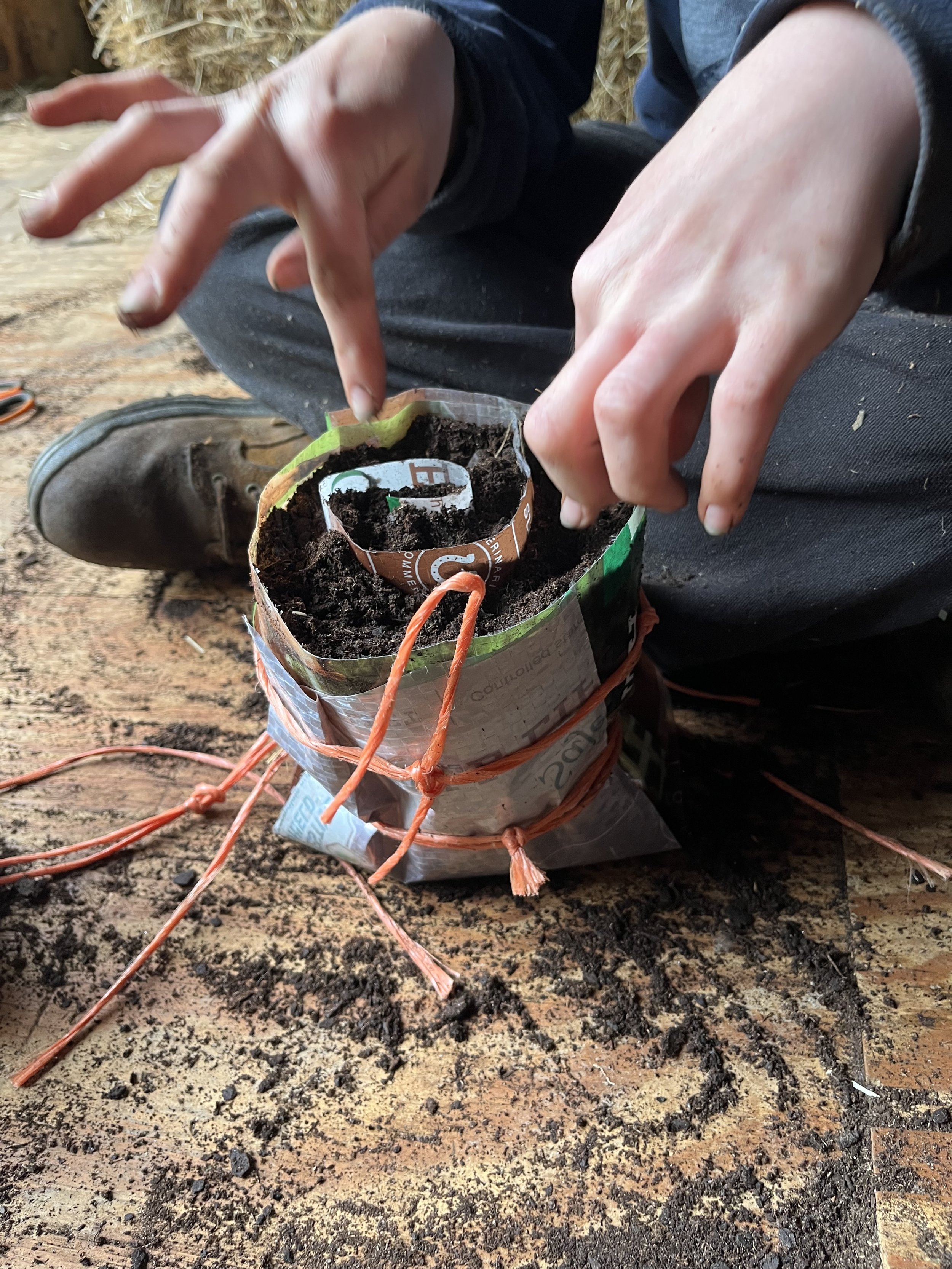
And just today, because why not, Abby and I tied up little sushi rolls of seed starters of Japanese indigo and true indigo that we mean to plant. . . In our spare time. So later, with more spare time, we can ferment it and turn it into dye, so that later, with even more spare time, we can dye things. The hilarity that we did that by cutting up empty grain bags and then tying them together with old spent baling twine—like blaringly loud reminders of the other huge responsibilities in my life—is not lost on me.
The farm is a wondrous place, filled with infinite possibility and infinite distractions. I can turn curiosities here into reality, sometimes businesses. But truly, this is also a place where dreams come to die. Just through the sheer lack of having enough time to tend to them all.
Sweet grass. Oi vey.