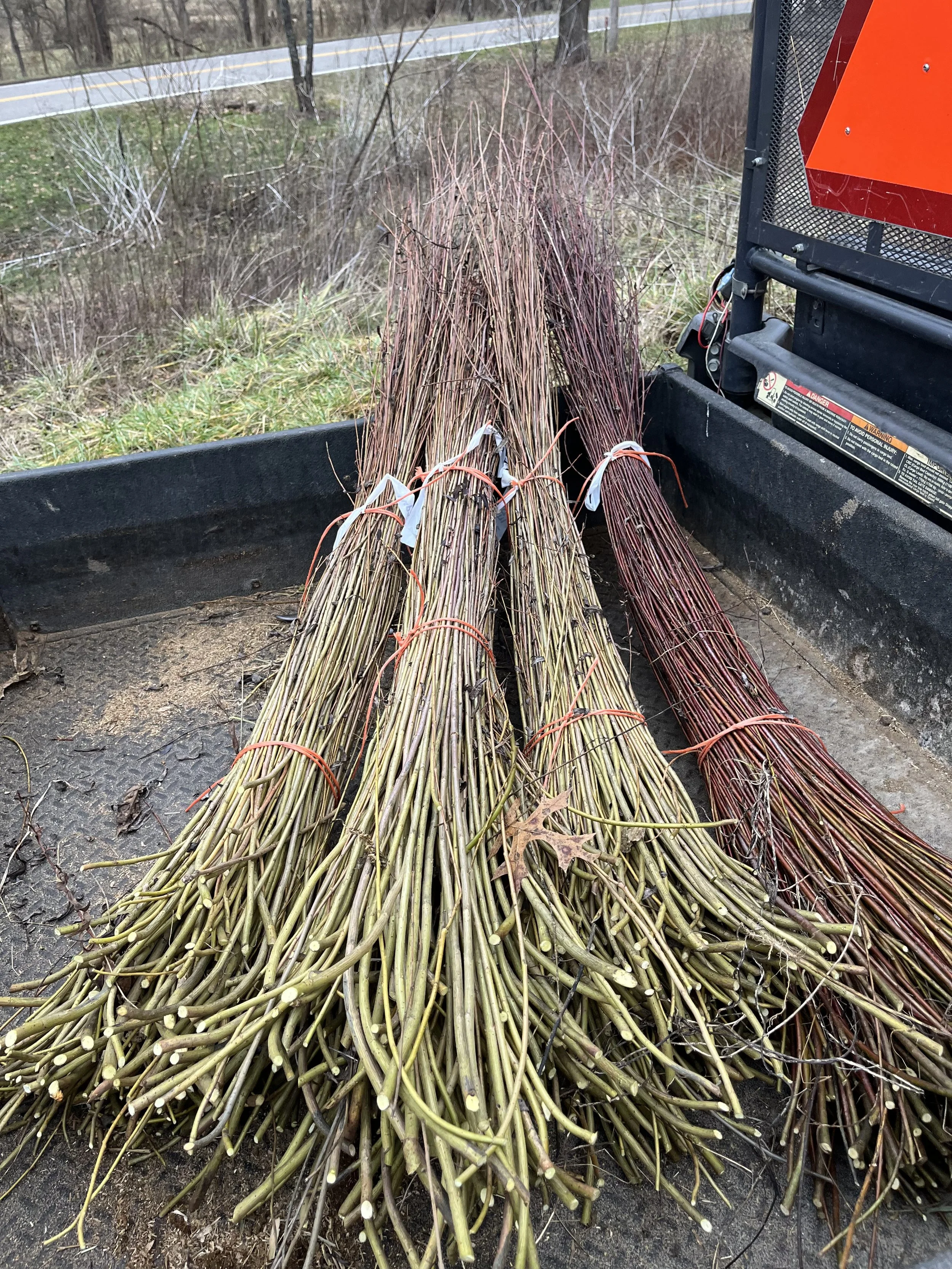
And so harvest begins. . .
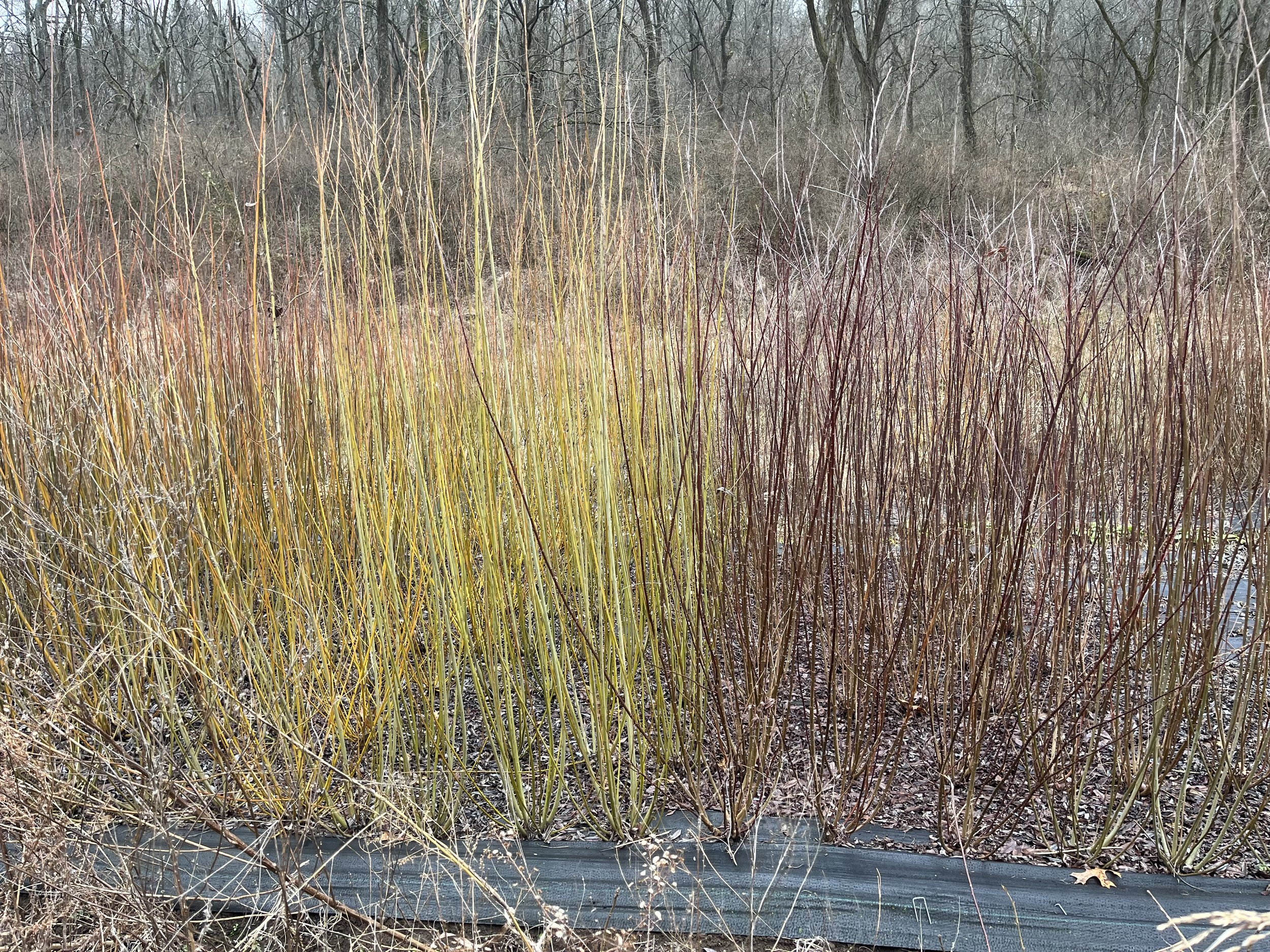
Leaves took forever to drop. We didn’t get properly started on willow harvesting until December 8th when I stole an hour from other work on the farm and cut down a patch of a new variety I was curious about—Arnold Select.
Arnold grew vigorously its first year. It’s a Salix miyabeana that I’m growing for height and sturdiness rather than beauty. It won’t likely show up in many baskets but instead be used for living willow projects. I’ve been watching it grow—9 feet tall in its first year—and it was the first variety I planned to cut this year.
Which has turned out to maybe be a bad choice. Weather had been up and down since the 8th. We’ve had 60 degree weather (69 tomorrow, in fact), but we’ve also had subzero overnight temps and 2 heavy-ish snowfalls for the Ohio River Valley. I like to plant as I harvest, but the weather hasn’t really been cooperating. Arnold is definitely a variety I want to multiply after its successful first year, but since I cut it, the ground has either been deeply gooshy or frozen solid.
Farming is hard.
But it’s also joyful. Abby and I are getting the opportunity to have longs days of snipping rods and chatting about art and aesthetics and life and politics (though that last one is so depressing right now that we try to limit how much we let ourselves dwell on that). It’s fun to watch the harvest stack up in the barn. The different rod colors, per usual, are a constant sense of interest and wonder.
Willow is so beautiful. I am not exaggerating when I say that Abby and I both interrupt one another’s harvesting to share individual rods of willow that we think are especially beautiful. They are as unique and striking as special rocks you might find and pocket while walking along a creek bed.
There’s a specific kind of bug damage, for example, that makes squiggly patterns in the willow bark, and once dried and reconstituted for weaving, it will make a golden imperfection that is especially beautiful on dark blue-green or reddish purple willow. We covet those. Sometimes we find pale green willow that is freckled with both darker and lighter spots that looks galactic—star strewn. Yellow willow—like bright crayon yellow—is often only bright yellow on the west-facing side of the rod while an equally intense red-orange on the eastern side. There are varieties of willow that are the palest chartreuse at the base shifting ombré-wise into wine red—colors that maybe only the bravest of us would pair in clothing colors, but nature puts together perfectly and without hesitation.
When people hear that we harvest all of our willow by hand, they are surprised. Rightfully so, maybe, since that means cutting, with clippers, over a hundred thousand rods (in subsequent years, it will be hundreds of thousands of rods). But seeing all of the individual rods is actually a joy. My hands are sometimes sore the day after a harvesting day. My back, too, complains. But it only occasionally feels like a chore. More often than not, it’s as enjoyable and mind-clearing as weaving a basket—repetitive, towards good ends, meditative—while out in fresh crisp air, surrounded by winter bird song.
We’ll get that Arnold Select in the ground still. I’m sure of it. Because farming IS hard, but willow is infinitely forgiving, lovely andhopeful.